Pre-Litigation PI Case Management: The Medical Side, Step by Step
A five-stage guide for PI attorneys and case managers: intake, care communication, records, costs and a medical package that makes unresolved questions visible.
Falcon Reach
Personal Injury Law Firms

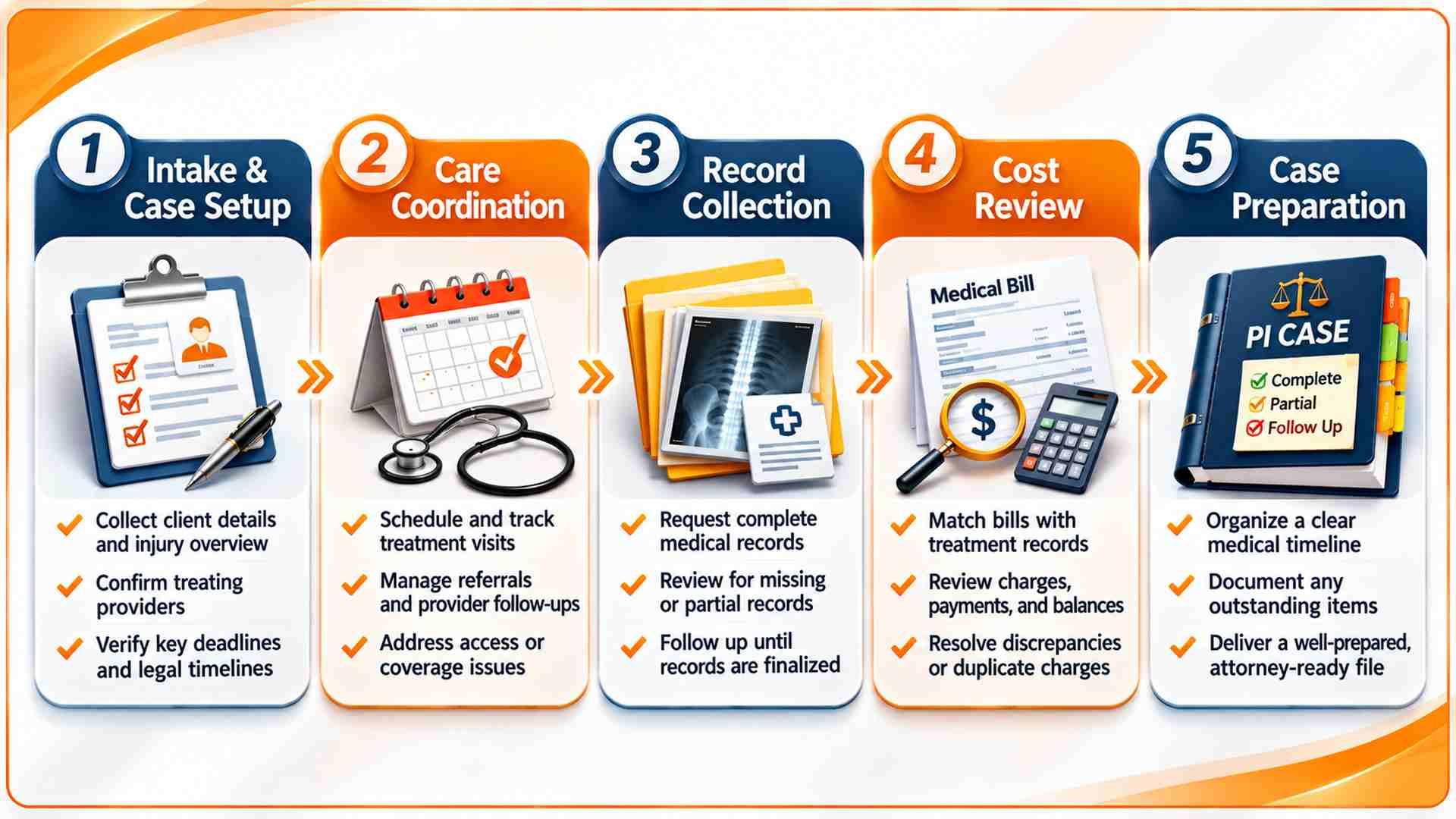
The medical side of the personal injury case management process runs from intake and treatment tracking through records collection, cost review and attorney review before a demand. Each stage should leave the firm with a usable output, an assigned owner and a next action for unresolved questions.
These stages overlap. Records collection can begin while care continues, and an attorney’s deadline decisions cannot wait for treatment or negotiations to finish. This guide focuses on the medical file within pre-litigation case management; counsel directs legal strategy and qualified clinicians make treatment decisions.
For a quick overview, the five stages are:
- Build an intake brief and identify the first actions.
- Track care-related communication and confirmed next steps.
- Collect records and build a traceable chronology.
- Reconcile medical costs and update the clinical outlook.
- Give counsel a reviewable package with explicit exceptions.
Step 1: Build an Intake Brief and Identify the First Actions
Give the attorney a concise starting picture: the incident date, reported symptoms, providers already seen, upcoming care, relevant prior treatment and known insurance or benefit coverage. Distinguish the client’s account from information supported by records. An uncertain fact should remain a question with an assigned task.
For example, a client may remember a hospital visit and an orthopedic office but not the imaging facility. Check available paperwork, record the unresolved provider search and assign someone to follow up. This is a hypothetical example, not a Falcon Reach client file.
Counsel should determine applicable filing deadlines, notice requirements and escalation dates. Staff can maintain the calendar under attorney supervision. A pending appointment, incomplete record set or ongoing negotiation is not a reason to defer that review.
Before requesting records, establish the applicable disclosure pathway. If relying on a HIPAA authorization, check its scope, authorized parties, purpose, expiration, signature and required statements against 45 CFR 164.508. Representative authority, sensitive records and additional applicable requirements may need counsel’s review. Identify the custodian and an appropriate secure delivery route.
Stage output: an intake brief, a provider list, counsel’s deadline instructions and an owner for each unresolved item. The brief can be usable while a provider search remains open, provided its uncertainty is visible.
Step 2: Track Care Communication and Confirmed Next Steps
Follow the clinician’s plan and the client’s decisions. From the firm’s side, confirm administrative progress: whether the provider received a referral, whether a visit is booked and whether attendance has been verified. Treatment selection and the need for further evaluation belong to qualified medical professionals.
Keep appointment status precise. A booking does not establish attendance, and an unanswered message does not establish that the client declined care. Record reported access barriers and assign an appropriate next action under the firm’s procedures. Direct treatment questions or new symptoms to medical professionals without staff attempting a clinical assessment.
For a provider introduction, the firm’s attorneys and case managers can prepare questions to ask an LOP medical provider about fit, communication and documentation. Confirm the provider’s acceptance and process directly rather than assuming that an introduction establishes a clinical referral or appointment.
Stage output: a current care-status note, confirmed next steps and unresolved communication issues for review. Set internal review dates according to the circumstances and escalate barriers to the supervising attorney.

Step 3: Collect Records and Build a Traceable Chronology
Begin collecting relevant existing material while treatment continues, then request targeted updates as new visits and referrals add information. The personal injury case management process needs both a current record set and a clear account of what remains outstanding.
Check each delivery against its request. A hospital may provide an imaging report without the image files. If the images were requested, mark that portion outstanding and confirm the correct custodian. If they were outside the original scope, create a separate task when counsel identifies the need. A missing production does not prove that care never occurred.
Maintain the request’s scope, submission evidence, assigned owner, current status and next review date. Distinguish a statutory response deadline, where applicable and verified, from the firm’s internal reminder. The guide to requesting and tracking medical records covers that collection workflow in more detail.
In the chronology, identify the encounter, provider and source page. Keep original productions separate from working summaries. Distinguish reported symptoms from examination findings and the clinician’s opinions. A note describing pain after an incident should not become an unsupported causation conclusion in a summary.
Stage output: an organized record set, a source-referenced chronology and an exception list. Close each request when its scope is satisfied or counsel accepts a documented limitation and next step.
Step 4: Reconcile Costs and Update the Clinical Outlook
Clinical and billing updates often arrive separately. Compare service dates and providers across treatment notes, itemized bills, payments, adjustments and balances. Keep those financial categories distinct. The guide to medical records in personal injury cases explains related documentation and evidence checks.
A billing entry may identify another records source. For example, a separate radiology charge can prompt a provider inquiry, but it cannot supply the missing imaging findings. Ask the relevant office about duplicate charges or unexplained balances, preserve its response and refer disputed issues to counsel.
Track known reimbursement interests from intake and identify information that remains provisional. For Original Medicare, CMS explains that a conditional payment letter is not a final repayment figure; additional payments may occur while a claim is pending. Other programs and plans require their own review. Counsel determines the legal significance of those interests.
When needed, obtain the treating clinician’s documented current outlook, including limitations, prognosis and recommended further care. Preserve uncertainty and distinguish a recommendation from an option merely discussed. Staff should not infer that treatment is complete from an inactive calendar.
Stage output: a dated treatment summary and reconciled cost schedule, with provisional figures and unresolved clinical or billing questions clearly marked.
Step 5: Give Counsel a Package With Explicit Exceptions
The stages of a personal injury case produce overlapping evidence, so the final medical handoff needs an index that matches its attachments. Counsel should be able to follow a material assertion back to the document supporting it. Include relevant prior history and unfavorable findings alongside supportive evidence.
Organize the package around three components:
- A dated medical chronology with source references and the clinician’s current outlook.
- Indexed supporting records and itemized costs, with payments, adjustments and balances distinguished.
- An exception list showing each material gap, why it matters, who owns the next action and when it will be reviewed.
Where practical, have another staff member check the source references and indexed attachments. A useful exception entry might read: image files outstanding; counsel’s requested comparison cannot proceed; assigned staff member to confirm the custodian and follow up. This is a hypothetical task description.
Counsel decides whether a gap needs more evidence, allows proceeding with a documented limitation or makes filing the immediate priority. Continue updating treatment and financial information during negotiations under the attorney’s direction.
Stage output: a reviewable package and an explicit record of unresolved issues. Being ready for attorney review does not mean every document has arrived or that a claim is legally ready to settle.
Keep the Next Action Visible
A practical PI case manager workflow makes four things easy to find: the current evidence, the remaining uncertainty, the person responsible and the next action. Use that check at every handoff rather than letting an unresolved question disappear when responsibility changes.
For firm-level support, explore Falcon Reach’s support for Texas PI law firms. Falcon Reach identifies the firm’s needs, arranges introductions to the medical partner and can coordinate communication and follow up when needed and requested. Patient information, clinical referrals and medical records go directly through the firm and the appropriate provider, never through Falcon Reach or its website forms.
Related solution
Explore Personal Injury Law Firms →About this article
Falcon Reach introduces Texas personal-injury law firms to its medical partner. This article is general information for law-firm professionals, not patient, medical, or legal advice. Do not send patient or claimant information through this site.
Falcon Reach
Falcon Reach makes introductions for Texas personal-injury law firms. It does not provide care or legal services.
Continue reading
Medical Records in Personal Injury Cases: A Guide for Law Firms
A practical guide to medical records for personal injury cases, medical chronologies, Texas affidavits, and evidence checks for attorneys and case managers.
How PI Teams Request and Track Medical Records
A practical guide to requesting medical records for personal injury claims, checking Texas deadlines, and tracking missing items through clear review.

Falcon focus. Real reach.
Falcon Reach connects businesses with the specialist teams in its own group of companies.