How PI Teams Request and Track Medical Records
A practical workflow for attorneys and case managers to identify record sources, confirm request authority, track deadlines, and review incomplete deliveries.
Falcon Reach
Personal Injury Law Firms

Executive Summary & Key Takeaways
- Clinical notes, bills, imaging reports, and actual images may come from different custodians.
- Identify the legal basis before calculating a deadline or challenging a fee.
- Give every request an owner, a status, and a next action.
- Mark requests complete after a scope review, rather than on delivery alone.
An MRI report has arrived, but the images are missing. The request looks finished in the inbox, yet the attorney still lacks something needed for review. For the case manager, the next task is finding the right custodian and keeping that gap visible.
Requesting medical records for personal injury claims works better as a documented process: identify the sources, confirm authority, send a specific request, track the response, and check what actually arrived. This guide gives attorneys and case managers a practical workflow, with Texas distinctions to check before setting deadlines.
1. Map the Treatment and Record Sources
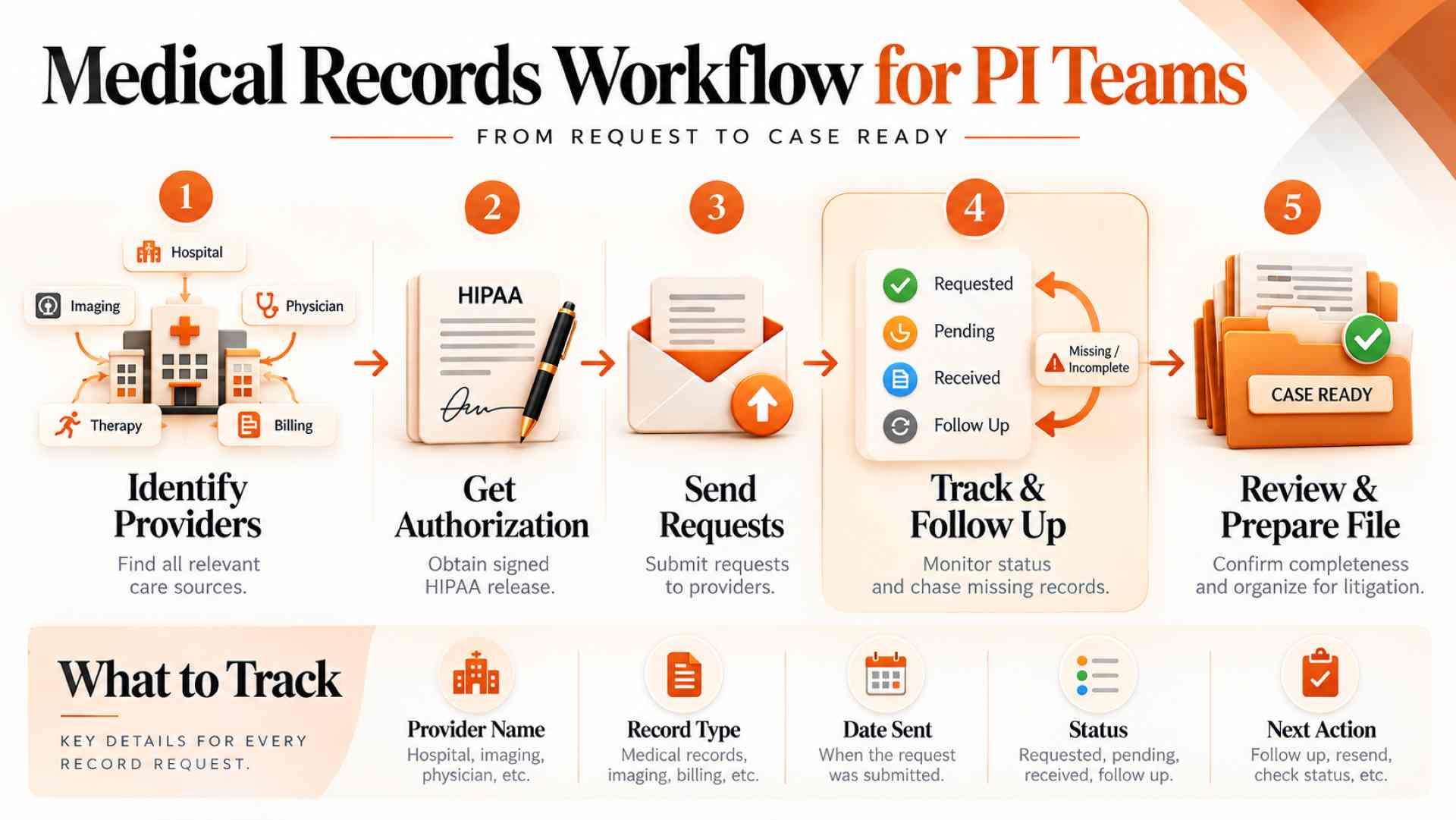
Start with the client’s treatment history, then compare it with intake notes, referrals, bills, and existing records. Ask which facilities handled emergency care, ambulance transport, imaging, physician visits, and therapy. A referral mentioned in one chart can reveal a source missing from the original list.
Identify the custodian responsible for each record. A hospital chart may not include a separately billed physician’s records or the imaging center’s image files. Confirm where each request belongs before submitting it.
Define the dates and categories counsel needs. For an emergency visit, that could include physician and nursing notes, discharge instructions, imaging reports, and itemized charges. Request actual images separately when needed. Consider relevant earlier treatment without automatically requesting an unnecessarily broad history.
If the firm is also evaluating a care relationship, our guide to questions to ask an LOP medical provider covers communication and documentation questions to raise before choosing a provider.

2. Confirm Authority Before Sending the Request
A medical records request letter from an attorney explains what the firm wants. It does not, by itself, establish permission to release protected information. Decide whether the request relies on the individual’s access rights, an authorization, or another applicable process.
For a HIPAA authorization, check the elements required by 45 CFR 164.508: the information covered, disclosing and receiving parties, purpose, expiration date or event, signature, and date. Check the required statements about revocation, conditioning treatment or benefits, and possible redisclosure. When someone signs as a representative, verify and describe that person’s authority. Representation by an attorney does not automatically establish HIPAA personal representative status.
For access requests under 45 CFR 164.524, the general federal period is 30 days. One extension of up to 30 days requires timely written notice explaining the delay and stating a completion date. That is not a universal deadline for every request made by a law firm.
Fees also depend on the pathway. The HHS notice on third-party access explains that the HIPAA access fee limitation does not apply to requests to transmit records to a third party. Check applicable state requirements before accepting or disputing an invoice.
3. Check the Rules for Medical Records Requests in Texas
A Texas address does not establish one deadline for every custodian. Record the provider type, authority, receipt date, and any applicable payment condition before entering a due date.
- Physicians: Texas Occupations Code 159.006 generally requires the requested information by the 15th business day after receipt of qualifying written consent or the specified physician request. Exceptions and denial requirements apply. The Texas Medical Board’s records guidance explains the physician requirement.
- Hospitals: Health and Safety Code 241.154 uses the 15th day after receipt of the request and authorized payment. It addresses recorded health care information other than payment information, including notice if the information does not exist or cannot be found.
- Electronic access: Section 181.102 addresses a person’s written request for their electronic health record when the provider’s system can fulfill it, generally within 15 business days, subject to access exceptions. It does not automatically govern every attorney request.
Have counsel confirm which provisions apply together. Sensitive records can require additional review. For example, 42 CFR Part 2 restricts use of covered substance use disorder records in proceedings against a patient. Consent for legal proceedings cannot be combined with consent for other uses. Confirm the required consent or court process before requesting or using those records.
4. Write a Request the Custodian Can Process
Include the necessary identifiers, requested dates, record categories, supporting authority, secure delivery instructions, and a firm contact. Verify the submission channel and keep evidence of delivery. An upload confirmation does not necessarily mean the custodian accepted the request as complete.
A scope paragraph might read:
Please provide emergency physician and nursing notes, discharge instructions, and imaging reports for the specified visit date. Please confirm the process for obtaining the associated CT images and any applicable charge.
This is an illustrative scope paragraph, not a complete authorization or legal form. Add the case-specific information through the firm’s approved process. Route billing requests to the correct department and record any clarification the custodian requires.
5. Build a Medical Records Request Tracking Log
Use a separate entry for each custodian and scope. A shared spreadsheet can work if access is controlled and ownership is clear. An existing case management system may already support the same fields.
- Request: internal reference, custodian, categories, and date range.
- Authority and submission: legal basis, authorization status, channel, and receipt evidence.
- Timing: applicable deadline, calculation basis, and separate internal reminder.
- Responsibility: owner, current status, and next action date.
- Delivery: fees, payment, material received, review findings, and secure file location.
Use clear statuses such as submitted, awaiting clarification, awaiting payment, partially received, under review, and complete. Keep statutory deadlines separate from internal follow-up dates. After a rejection, review both the problem and the governing deadline; do not assume every clock restarts.
For example, if an MRI report arrives without requested images, mark the request partially received. Check the original scope, confirm who holds the images, and send a targeted follow-up. Record the answer and the next review date. Avoid duplicate requests that obscure which submission remains open.
6. Review Deliveries Before Closing Requests
Check identity, dates, readability, and requested categories first. Compare the delivery with the original request, then flag gaps for the attorney. Notes, reports, images, and bills serve different purposes. Records can support an assessment of injuries and expenses without independently proving accident causation or guaranteeing recovery.
If the custodian cannot find records, verify identifiers, facility names, dates, and the department searched. Preserve the response. An unsuccessful search does not establish that treatment never occurred.
Close the request after a reviewer confirms completion or documents the unresolved exception and counsel’s next step. Continuing treatment may require an updated request. Keep original files and correspondence in the firm’s controlled case system, verify recipients before sharing, and follow restrictions governing sensitive records.
Frequently Asked Questions
Which records should a PI team request?
Request the categories and dates relevant to counsel’s review. These may include treatment notes, imaging reports, actual images, and bills. Check referrals for additional custodians.
Is a signed attorney request enough?
Not by itself. Confirm the legal pathway, required authorization or other authority, and the signer’s capacity before submission.
What should happen when a delivery is incomplete?
Identify the missing item, confirm it was requested, and seek a specific response. Keep the request open until reviewed or closed with a documented explanation.
Keep the Next Step Clear
A useful records process shows what was requested, what arrived, what remains missing, and who acts next. Review the log before demands, depositions, and other case milestones so counsel can address gaps while there is still time to respond.
For a separate need involving a medical partner, explore Falcon Reach’s support for Texas PI law firms. We can introduce your firm to a medical partner and, when needed and requested, coordinate communication and follow up. The specialist team delivers its services. Tell us about your firm’s needs without sending patient details or case files.
General information for law firms, not legal advice. Counsel should verify the requirements that apply to each request.
Related solution
Explore Personal Injury Law Firms →About this article
Falcon Reach introduces Texas personal-injury law firms to its medical partner. This article is general information for law-firm professionals, not patient, medical, or legal advice. Do not send patient or claimant information through this site.
Falcon Reach
Falcon Reach makes introductions for Texas personal-injury law firms. It does not provide care or legal services.
Continue reading
Medical Records in Personal Injury Cases: A Guide for Law Firms
A practical guide to medical records for personal injury cases, medical chronologies, Texas affidavits, and evidence checks for attorneys and case managers.
Questions to Ask Before Choosing an LOP Medical Provider
Questions for Texas PI attorneys and case managers comparing LOP medical providers: clinical fit, written terms, billing, records, and communication.

Falcon focus. Real reach.
Falcon Reach connects businesses with the specialist teams in its own group of companies.