Questions to Ask Before Choosing an LOP Medical Provider
A practical review checklist for Texas personal-injury attorneys and case managers: clinical fit, written LOP terms, billing, records, and communication.
Falcon Reach
Personal Injury Law Firms

Executive Summary & Key Takeaways
- •Check clinical suitability and the treating clinician’s credentials before focusing on appointment availability.
- •Review the actual LOP, including covered services and responsibility if recovery is insufficient.
- •Confirm records, billing, and communication procedures with named contacts and a backup.
- •Resolve essential gaps before referral. Do not rely on promises about bill reductions or case outcomes.
When comparing LOP medical providers, acceptance of a letter of protection is only the starting point. Texas personal-injury attorneys and case managers also need to know who will treat the client, what the agreement requires, and how the practice handles records, billing, and changes in care.
A useful review produces written answers and clear responsibilities. The attorney assesses the agreement and professional obligations. The case manager checks whether the process will work day to day. These questions help both reach a documented decision before recommending a practice.
What Does the LOP Require From the Client?.
A letter of protection is a written payment arrangement commonly connected to an anticipated personal-injury recovery. It should not be treated as insurance coverage or a guarantee of settlement. The agreement’s wording matters more than a clinic’s general statement that it accepts LOPs.
For a letter of protection in Texas, ask counsel to identify who owes the balance, when payment becomes due, and what happens if the claim is denied, abandoned, or produces insufficient recovery. Ask who will explain these obligations to the client and how the firm will record that discussion. Keep the accepted agreement in the firm’s approved case records.
Before sending a letter of protection to a medical provider, confirm the correct legal entity, covered services, and authorized recipient. Obtain written acceptance. Check whether imaging facilities or outside specialists require separate arrangements; one clinic’s agreement should not be assumed to cover its referrals.
Also consider available payment options, including insurance where applicable. The client should understand the proposed arrangement and any unresolved responsibility before agreeing to it.
Can the Practice Provide the Care the Client Needs?.
Identify the treating clinician and verify the relevant professional license. For professions it regulates, the Texas Medical Board license lookup is a starting point. Confirm the practice’s clinical scope and when it refers elsewhere. A convenient appointment is useful only if the available care fits the client’s needs.
Ask how the clinician conducts the initial assessment, reviews progress, and decides whether to change the plan or seek another specialist. If staff recommend a set course of treatment before a clinician has examined the client, ask how the plan will be tailored to the findings.
The attorney and case manager should confirm that a reassessment process exists, rather than choose treatment themselves. Ask whom the case manager contacts when symptoms or practical circumstances change. The firm’s screening process should not delay access to urgent clinical assessment.
A practice should be clear about its limits. Promises that a procedure will increase settlement value are a warning sign. Clinical decisions belong to the treating clinician and patient.

Are Charges and Financial Responsibilities Clear?.
Request written rates or an estimate where feasible. Ask what is included and which charges may come separately, such as imaging, facility fees, outside consultations, supplies, or missed appointments. If a cost cannot yet be estimated, identify who will explain it before the patient commits.
Ask the billing team how it provides itemized statements and records payments, credits, and adjustments. Counsel should confirm the requirements applicable to the practice and agreement. The case manager needs a contact who can resolve an unexplained charge or reconcile an updated balance.
Who Can Discuss a Reduction or an Assigned Balance?
If the practice says it negotiates at resolution, ask for its process. Is a reduction discretionary? Who can authorize it? A willingness to consider a request does not establish the eventual balance.
Also ask whether the receivable may be assigned or sold. Have counsel review the relevant provisions and notice process. Confirm who would control the balance afterward; the original clinic’s billing contact may not retain authority to negotiate.
How Will the Firm Obtain Complete, Accurate Records?.
Get the authorization requirements, submission address, applicable fees, and escalation route. The case manager should be able to confirm receipt and identify missing items. Ask whether the practice can supply diagnostic reports and records received from outside clinicians, or whether separate requests are needed.
Have counsel confirm the release rules and deadlines for the record holder, including exceptions. Ask which requirements apply to the specific record holder and request type, and record that guidance with the workflow. Keep legal requirements separate from the office’s proposed turnaround, and avoid assuming that one deadline applies to every healthcare professional.
For example, a promise of quick delivery is hard to use if nobody can confirm that the authorization arrived. Ask how incomplete requests are identified and who handles overdue or missing reports.
Before the first referral, walk through a hypothetical records request with the administrative contact: where would the authorization go, how would receipt be confirmed, and who would follow up if a report were missing? This can reveal an unclear handoff without sharing a real client’s information.
Do the Notes Explain the Course of Care?
Ask for a blank template or a properly deidentified sample through an appropriate process. Look for examination findings, functional limitations, response to care, and reasons for changes in the plan. Confirm the documented process for correcting factual errors.
Records may include normal findings, preexisting conditions, or uncertainty. The firm should never ask a clinician to alter findings to support a preferred account. If reports or affidavits are needed, confirm what the practice can supply and let counsel assess their suitability.
Who Handles Changes and Unresolved Requests?.
A named contact helps only if the role is clear. Establish a primary administrative contact, a backup, and an escalation route. Confirm which updates can be shared under the patient’s authorization and who communicates with the patient directly.
- Who communicates appointment, referral, or treatment-plan changes to the firm, as authorized?
- Who resolves missing records, disputed invoices, or duplicate charges?
- Who provides an updated balance and confirms that a correction is complete?
The attorney and case manager should agree on which issues need legal review and which can be resolved administratively. Record the request, acknowledgment, responsible person, and follow-up date in the firm’s approved system.
Ask how the office handles a change of attorney, a pause in care, or a client who cannot attend. Confirm who needs notice and which issue requires the patient’s involvement. Do not infer those answers from a general intake policy.
How Should the Firm Make the Final Decision?.
Separate essential requirements from preferences. An unsuitable clinical scope or pressure to change records should stop the recommendation. Missing written terms need clarification. Appointment timing must be considered alongside the clinician’s assessment of urgency and the client’s ability to attend.
Provider Review Checklist
Record the evidence behind each answer, who confirmed it, and any unresolved issue. Comparing LOP providers should lead to a workable process, not simply a completed form. Revisit the assessment if the client’s needs change.
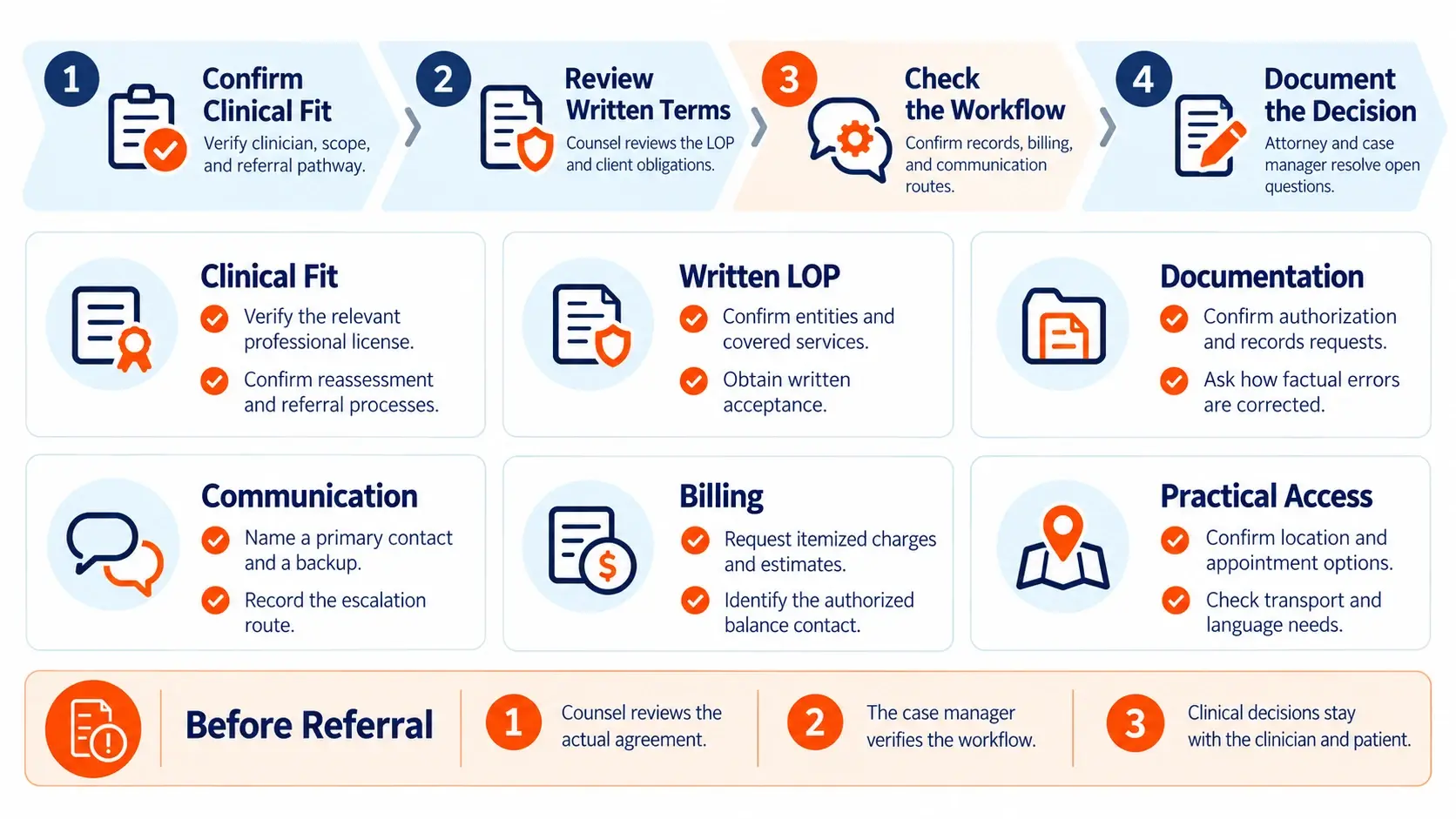
View the full-size provider review infographic.
Keep a short provider profile with the accepted document version, clinical scope, billing contact, records address, and date of verification. Assign someone to update it when the practice changes its staff or process. A stale contact list can undermine an otherwise sound review.
Frequently Asked Questions.
Does an LOP Mean Treatment Is Free?
Do not assume so. Counsel should explain the client’s responsibility under the actual agreement, including what happens if the claim fails or recovery is insufficient.
Does Accepting an LOP Cover Every Outside Provider?
Do not assume that either. Ask whether imaging facilities, consulting specialists, and other separate entities need their own written arrangements.
Should Appointment Availability Decide the Choice?
Consider availability alongside clinical fit, written terms, records access, and the client’s practical needs. An available appointment cannot resolve an unsuitable scope or an unanswered agreement question.
A Medical Introduction for Your Firm.
Falcon Reach connects businesses with specialist teams in its own group of companies and is paid by the companies it introduces. For Texas PI attorneys and case managers, it introduces one medical partner in the group. It does not compare the market or provide clinical care.
Learn how the medical introduction works for Texas PI firms. To discuss an introduction, contact Falcon Reach about your firm’s needs. Confirm eligibility and LOP terms directly with the medical partner. Send only firm-level information through Falcon Reach; patient names, records, case files, and claimant details belong in the appropriate direct channel with the medical practice.
Related solution
Explore Personal Injury Law Firms →About this article
Falcon Reach introduces Texas personal-injury law firms to its medical partner. This article is general information for law-firm professionals, not patient, medical, or legal advice. Do not send patient or claimant information through this site.
Falcon Reach
Falcon Reach makes introductions for Texas personal-injury law firms. It does not provide care or legal services.
Falcon focus. Real reach.
Falcon Reach connects businesses with the specialist teams in its own group of companies.