Medical Records in Personal Injury Cases: A Guide for Law Firms
A practical guide for attorneys and case managers to review medical records, build source-based chronologies, distinguish Texas affidavits, and identify evidence gaps.
Falcon Reach
Personal Injury Law Firms

A missing imaging report can change an expert’s assessment. A copied history can turn a patient’s account into an apparent medical conclusion. Reviewing medical records for personal injury cases means deciding what the documents support before those details enter a demand, deposition, or trial exhibit.
This guide helps attorneys and case managers check completeness, build a medical chronology, and distinguish Texas affidavit procedures. Counsel remains responsible for evidentiary decisions and case-specific deadlines.
Start With What the Records Actually Support
A patient’s pain report, a measured strength deficit, and a clinician’s causation opinion answer different questions. Keep those distinctions in the summary. A note recording symptoms after a collision establishes reported timing; it does not necessarily express a medical opinion about causation.
Compare relevant symptoms, function, examinations, and treatment before and after the incident. A preexisting condition may raise an aggravation question. An unchanged diagnosis can coexist with a documented change in limitations. Imaging findings also need clinical context before a reviewer describes them as traumatic or newly developed.
The attorney should identify the legal and expert questions. The case manager can organize the source material and flag gaps for review, without turning an administrative summary into a clinical assessment.
Collect a Complete, Current Record Set
Start with providers identified at intake, then follow referrals and billing entries. A hospital production may omit separately maintained ambulance, radiology, specialist, or rehabilitation files. Request defined date ranges and record what each provider supplied. A documented visit missing from a response is a collection question, not proof that care never occurred.
Depending on the matter, the working checklist may include:
- Clinical notes, relevant orders, and operative records.
- Diagnostic reports and the actual images needed for expert review.
- Discharge instructions, therapy notes, and documented functional limitations.
- Itemized bills, payment information, adjustments, and remaining balances.
- Relevant earlier records and updates during continuing treatment.
For the collection workflow, see how PI teams request and track medical records. Identify the legal authority, intended recipient, scope, and any special restrictions before sending a request. Patient-access rules should not be treated as universal deadlines for every attorney request.
Assign an owner to each outstanding request and record why the missing item matters. Earlier imaging may affect expert review; an incomplete bill may prevent reconciliation. Those differences help the team prioritize follow-up.
Preserve Originals and Check Completeness
Keep original productions separate from annotated working copies. Log requested and received date ranges, missing pages, provider contacts, and the next action. Restrict access by matter and role, verify recipients before transmission, and retain amendment history. Counsel should review redactions against discovery obligations and any protective order.
Organize the review around three questions:
- Clinical course: What symptoms, findings, treatment changes, and functional limitations are documented?
- Record quality: Are dates inconsistent, pages missing, amendments unexplained, or statements attributed unclearly?
- Financial detail: Do service dates, charges, adjustments, payments, and balances reconcile?
A visit listed in a bill but absent from the clinical file should generate a specific follow-up task. Preserve both records rather than filling the gap with an assumption.
Build a Medical Chronology With Source References
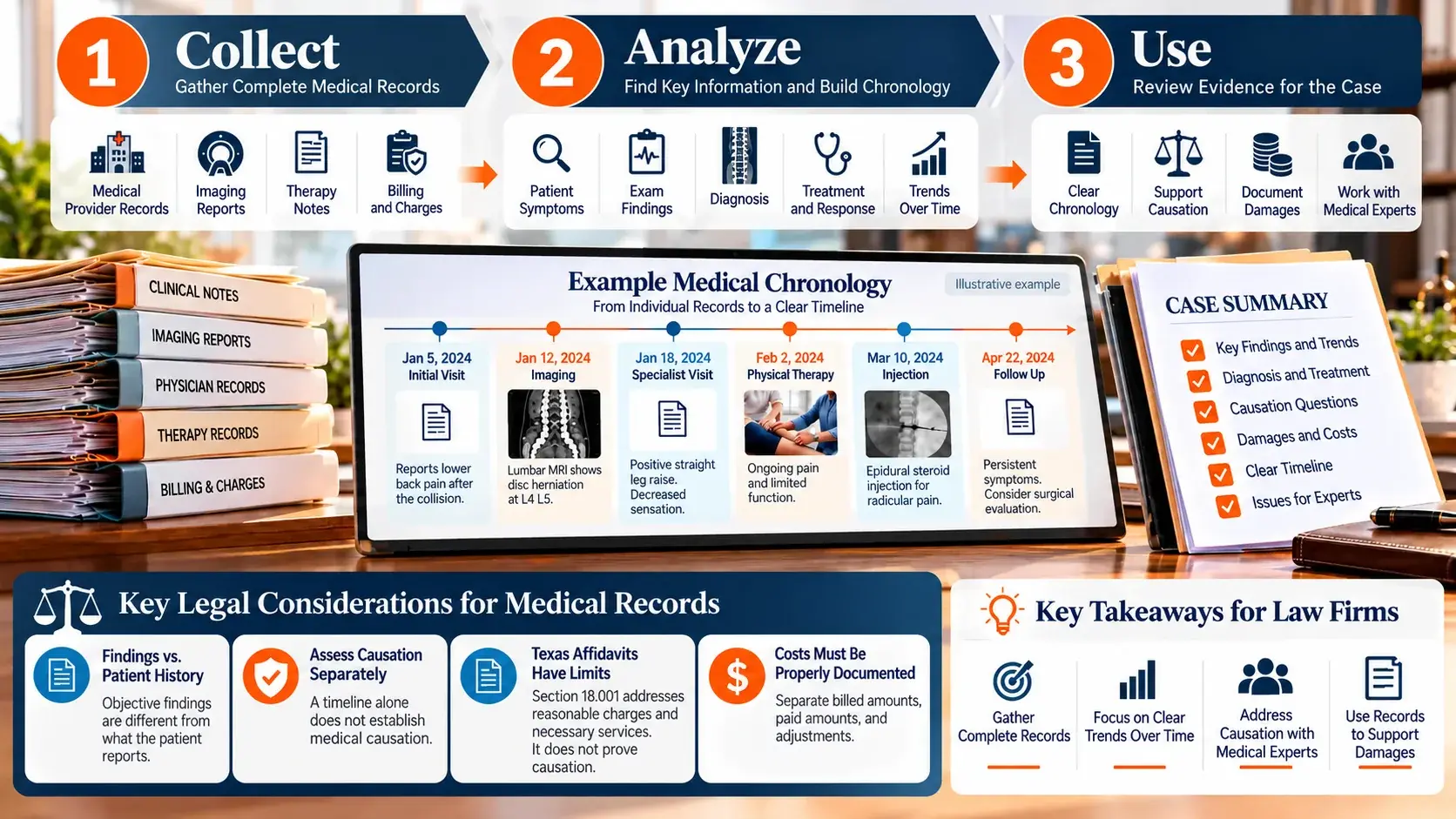
A medical chronology should let another reviewer locate the evidence without asking what an entry means. Record encounter dates separately from signature dates, identify the author or provider, and use stable page references. Keep quotations distinct from paraphrases and put analyst questions in a clearly marked field.
Consider this hypothetical entry:
April 8, emergency department, pages 12 to 15: patient reports neck pain after a collision; examiner documents normal upper extremity strength; discharge instructions recommend follow-up. No imaging report appears in this production.
The entry captures reported symptoms and examination findings while identifying a collection question. It makes no unsupported diagnosis or causation claim. Later symptoms or a changed examination belong in later entries, without rewriting the initial encounter.
Where notes conflict, cite both accounts and describe the discrepancy. Do not quietly choose the version that favors the case. Counsel needs to see the issue before an opposing reviewer raises it.

Identify Which Texas Affidavit You Need
The phrase Texas medical records affidavit can refer to documents with different purposes. Authentication of business records, proof of reasonable charges and necessary services, and proof of injury causation are separate questions.
Business Records and Authentication
Texas Rules of Evidence 803(6) and 902(10) address business records and authentication through qualifying affidavits or declarations. Authentication does not resolve every hearsay, relevance, or other admissibility objection to the contents. Rule 902(10) ordinarily requires service of the records and accompanying affidavit at least 14 days before trial, subject to its good-cause provision.
Reasonable Charges and Necessary Services
An 18.001 affidavit follows a separate statutory procedure concerning charges and necessary services. It does not prove causation. Check the affiant’s authority, oath, and itemized attachment; Section 18.002 supplies forms. Assess the document by its language and legal basis, rather than its filename.
Calendar Service, Notice, and Response Deadlines
Section 18.001 generally places initial service at the earliest of 90 days after the defendant’s answer or the applicable expert-designation deadlines. Providers first furnishing services after the answer fall under a separate provision. Counsel must identify which rule applies to each provider.
Ordinary counteraffidavit service uses the earliest of 120 days after the answer or the relevant expert deadlines. The response provision for newly treating providers uses different timing, including a later-of calculation. Continuing services can permit supplementation by 60 days before trial for affidavits and 30 days before trial for counteraffidavits.
Track service and the required notice to the clerk as separate tasks. Agreements or court permission may alter deadlines. Keep the governing provision, any order or agreement, and the responsible reviewer beside each calendar entry.
Review Challenges and Reconcile Medical Costs
A counteraffidavit needs an appropriately qualified affiant and reasonable notice of the challenge’s basis. Review the disputed services and amounts individually. A partial challenge does not automatically remove support for every charge from that provider.
In Ortiz v. Nelapatla , decided May 1, 2026, the Texas Supreme Court held that unchallenged portions of partially controverted medical-cost affidavits can remain competent evidence for the factfinder. Counsel should identify the disputed portions, appropriate redactions, and any additional evidence needed. The decision guarantees no recovery and supplies no missing causation evidence.
Section 41.0105 separately limits recovery of medical expenses to amounts actually paid or incurred by or on behalf of the claimant. Distinguish gross charges from adjustments and enforceable balances. An affidavit does not replace that analysis.
If care was provided under a letter of protection, reconcile the written terms with the billing file. Our questions to ask an LOP medical provider cover that separate review.
Check the File Before a Demand or Expert Handoff
Ask a second reviewer to test material assertions against their sources. Can they identify who made each observation, find the supporting page, and distinguish a question from a supported conclusion?
Investigate treatment gaps without assuming their cause. Interrupted care might reflect improvement, access barriers, or another explanation. Seek supporting information before adding that explanation to the narrative. Retain the full relevant source set so a selective summary does not hide information the recipient needs.
Frequently Asked Questions
Which medical records should law firms request?
Request the relevant clinical notes, diagnostic reports, images, treatment records, and itemized bills. Follow referrals to identify additional providers and check received material against the requested scope.
What should a medical chronology include?
Include encounter dates, providers, findings, treatment changes, and source references. Separate patient reports from clinical observations and mark unresolved questions.
Does a Texas Section 18.001 affidavit prove causation?
No. It concerns reasonable charges and necessary services. Injury causation needs separate supporting evidence.
Does a counteraffidavit invalidate every charge?
Not necessarily. Ortiz v. Nelapatla confirms that unchallenged portions can remain evidence when medical-cost affidavits are only partially controverted.
Discuss Your Firm’s Medical Partner Needs
Falcon Reach can introduce Texas PI attorneys and case managers to a medical partner, with communication coordination and follow-up available when needed and requested. Explore our support for Texas personal-injury law firms. Falcon Reach does not retrieve or review medical records or provide legal or clinical services. Do not send patient details or case files through the website.
General information for law-firm teams, not legal or medical advice. Counsel should verify the current law, court orders, and requirements for the matter.
Related solution
Explore Personal Injury Law Firms →About this article
Falcon Reach introduces Texas personal-injury law firms to its medical partner. This article is general information for law-firm professionals, not patient, medical, or legal advice. Do not send patient or claimant information through this site.
Falcon Reach
Falcon Reach makes introductions for Texas personal-injury law firms. It does not provide care or legal services.
Continue reading
How PI Teams Request and Track Medical Records
A practical guide to requesting medical records for personal injury claims, checking Texas deadlines, and tracking missing items through clear review.
Questions to Ask Before Choosing an LOP Medical Provider
Questions for Texas PI attorneys and case managers comparing LOP medical providers: clinical fit, written terms, billing, records, and communication.

Falcon focus. Real reach.
Falcon Reach connects businesses with the specialist teams in its own group of companies.