Who Owns Your Data and Code? Questions to Ask AI Vendors
Before buying AI software, clarify who can use your information, which code rights transfer, how access is tested, and what your team can take with it at exit.
Falcon Reach
AI & Automation

The most useful questions to ask AI vendors go beyond who owns an uploaded file or a block of generated code. You also need to know what the supplier can reuse, which licenses your application depends on, who can access sensitive information, and whether your team can keep working after the contract ends.
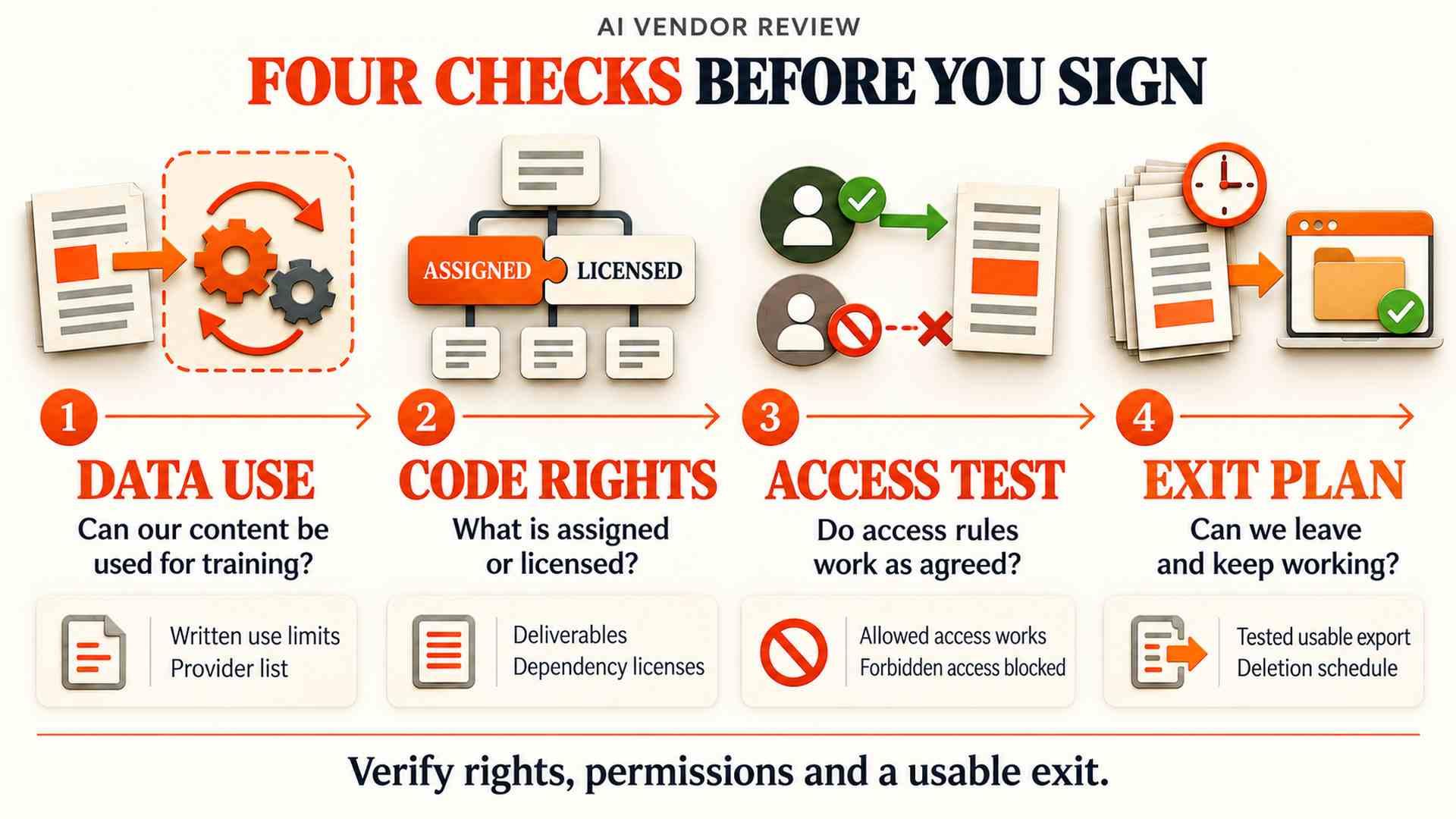
Before signing, ask for four things: written limits on data use, a clear schedule of code rights, evidence that permissions work, and a tested exit package. An ownership promise is only part of that review.
This guide is for business owners approving an AI purchase and the operations, procurement, and technical teams responsible for using it. It provides purchasing questions, not legal advice. Have qualified counsel review the agreement for your situation and governing law.
1. What can you do with our information?
Ask the vendor to map uploaded files, prompts, outputs, conversation history, and operational logs. Include embeddings, the numerical representations used to search or compare content. For each category, record its purpose, who receives it, where it is processed, and how long it stays.
“You retain ownership” does not explain the permissions you grant the supplier. Ask whether it can reuse content for product improvement, share it with other providers, or retain it after termination. Check the signed definitions and licenses rather than relying on a sales email.
Confirm your own permission to upload the material, too. Customer information, licensed documents, and personal data can carry obligations that your vendor agreement does not remove.
2. Can anyone train on or review our content?
Ask: “Does the restriction cover model training, fine-tuning, evaluations, human review, and feedback across every feature we plan to enable?” A promise about one business product may not describe an optional connector or a different account type.
Request the applicable terms and a demonstration of the settings. Identify exceptions for security monitoring or support, including their access limits and retention. Check downstream model providers and subcontractors as well as the company you are paying.
For AI vendor contract language, ask counsel to define permitted processing purposes, the content categories covered, and when additional written authorization is required. Align those terms with feedback provisions and incorporated policies so a narrower promise is not undermined elsewhere.

3. Who owns AI-generated code under this agreement?
Separate four categories: your existing materials, custom work created for you, the vendor’s pre-existing components, and third-party dependencies. Request a deliverables schedule showing what is assigned, what is licensed, when rights transfer, and which charges continue.
Contract rights and copyright protection are different questions. The U.S. Copyright Office’s report on AI and copyrightability explains that protection depends on sufficient human authorship. Purely AI-generated material is not protected under U.S. copyright law; qualifying human contributions may be. The assessment is case-specific, and prompts alone generally do not provide sufficient control over expression.
A contract cannot create copyright where it does not otherwise exist. Ask the supplier to identify the rights it can transfer, document substantive human contributions, and explain relevant limitations. An ownership label does not guarantee exclusivity or clear third-party rights.
4. Can we modify, host, and maintain the complete application?
If your purchase includes custom software and app development, check whether your team can run and change the delivered system without the original developer. “You own the custom code” offers limited practical freedom if essential vendor components require a subscription that can end.
Request a dependency inventory and the licenses, notices, and restrictions that apply. Confirm whether another developer can maintain the application, whether customer distribution is permitted, and what happens to necessary licenses when support ends. Do not assume source-code access includes every right your business needs.
Discuss infringement claims with counsel: who handles the defense, which exclusions and liability caps apply, and whether replacement or remediation supports continued operation. Record those answers alongside the technical dependencies.
5. Security questions to ask AI vendors
Start with the workflow you intend to buy. For example, in a hypothetical distributor, an employee who searches product specifications should not gain access to confidential supplier pricing. Use invented records and accounts with different permissions to test that boundary.
- Can an authorized user retrieve the information they need?
- Does restricted content stay inaccessible through answers, search results, and exports?
- Can instructions hidden in a document or prompt bypass permissions or trigger an unapproved action?
- Does revoking access stop later retrieval, and do logs show the user, action, resource, time, and outcome?
Agree on acceptance criteria and record failures before approval. Access restrictions and action approvals should be enforced by the application and connected systems, rather than depending only on instructions telling the model to behave.
Also review administrator access, authentication, encryption, and separation between customers. Ask for assessment evidence covering the service you will use, its period, exceptions, and remediation status. A certification logo alone does not answer those questions.
6. Who processes our data and handles incidents?
Obtain the provider and subcontractor list with their roles, processing locations, and support-access arrangements. Regional hosting does not necessarily tell you where staff can access the information. Establish notice and objection procedures for material provider changes.
Ask who notifies you of an incident, what triggers that notice, the agreed timing, and how updates will arrive. Identify responsibility for investigation, evidence preservation, recovery assistance, and costs, including incidents first discovered by a downstream provider. Avoid treating an undefined promise of “prompt notification” as a complete incident plan.
7. What will we receive when we leave?
Request a sample export before committing to the service. For a custom application, agree on repositories, build instructions, configuration, prompts, retrieval content, and evaluation records. Identify proprietary services or model components that cannot transfer.
Have your technical team or a replacement developer build and run the agreed application from that package in a clean environment. A successful download is not the same as a usable handover. For a hosted product without transferable source code, test whether its exported data can support migration to a replacement.
Set export formats, deadlines, assistance fees, and access after termination in writing. Keep credentials out of ordinary archives and arrange a secure handover or replacement of the access your team actually needs.
8. What gets deleted, and what can remain?
Ask separately about original files, logs, backups, embeddings, and any model artifacts covered by the agreement. Obtain a deletion schedule, confirmation of completion, and details of legal retention requirements or technical limits.
If training was permitted, ask what deletion means for trained models. Removing an uploaded document does not necessarily reverse its downstream use. For retained copies, agree on restricted purposes and access until deletion. Keep these commitments specific to the service and data involved.
Turn the answers into a purchasing decision
Keep a short approval record: the intended workflow, permitted data uses, assigned and licensed assets, test results, accepted exceptions, and the person responsible for each unresolved issue. Reconcile the order form, service terms, processing agreement, and incorporated policies, including which document takes precedence.
The right questions to ask AI vendors should help your team decide whether to proceed, narrow the scope, or pause. Revisit that decision when a new connector, provider, or feature changes the approved conditions.
Considering AI and workflow automation for your business? Falcon Reach helps clarify your needs and connect you with a relevant specialist team. The specialist team scopes and delivers the technical work; Falcon Reach can also help with coordination and communication follow-up when needed and requested. Tell us about the workflow you want to improve, without sending confidential records or credentials.
Related solution
Explore AI & Automation →About this article
Falcon Reach connects businesses with the specialist teams in its own group of companies. This article is general information, not professional advice for a specific situation.
Falcon Reach
Falcon Reach connects businesses with the specialist teams in its own group of companies, for AI and automation, software, IT, design and marketing.
Continue reading
Questions to Ask a Marketing Agency Before You Hire
Compare marketing agencies on strategy, KPIs, fees, account access and handover. Get practical questions to ask before you sign a new agency contract.

Falcon focus. Real reach.
Falcon Reach connects businesses with the specialist teams in its own group of companies.