Questions to Ask a Marketing Agency Before You Hire
Compare agency proposals with practical questions about strategy, measurement, delivery, AI use, fees, account access, and handover before committing your business.
Falcon Reach
Digital Marketing

Before hiring an agency, get clear on the decisions you are asking it to help you make. A polished proposal may explain the channels and monthly fee while leaving out who approves the work, how results are checked, or what happens when the relationship ends.
These questions to ask a marketing agency help business owners and marketing leads compare the substance of an offer. Ask each finalist the same questions, involve the person who will manage the relationship day to day, and request written answers before signing.
1. What would you investigate before recommending a plan?
Start with the business problem. More traffic may do little for a business whose existing inquiries go unanswered. An awareness campaign may serve a different purpose from work intended to support immediate sales.
Ask which information the agency needs about customers, margins, demand, sales capacity, and current performance. A useful answer explains how the findings could change the plan. An audit has value when it informs a decision.
If you are exploring support for search, social media, or advertising, clarify the brief before approaching digital marketing specialists. Give each finalist the same scenario: visits increased, but sales stayed flat. Ask what it would check before recommending additional spending.
2. Have you worked with constraints like ours?
Relevant experience includes budget, geography, sales cycle, and internal capacity as well as industry. Ask what the agency would adapt for your circumstances and where it would need additional expertise.
For case studies, request the starting position, timeframe, investment, and the agency’s specific contribution. Ask what else changed in the business during that period. Where permission is available, speak with a comparable client about communication, setbacks, and unexpected costs. A large result without this context is difficult to assess.

3. What do you do when a campaign underperforms?
Request an example the team can discuss without exposing confidential information. What assumption proved wrong? Which evidence showed the problem? Why did the agency change, reduce, continue, or stop the activity?
Agree on review points, spending approval, and the evidence needed for further investment. Allow for your customers’ buying cycle and distinguish a delivery deadline from a performance forecast. For SEO work, Google’s guidance on hiring an SEO cautions against guaranteed first-place rankings. Ask the agency to explain the assumptions and limitations behind any forecast.
4. Which marketing agency KPIs will guide decisions?
Choose marketing agency KPIs around the assignment. A service business may track qualified inquiries and sales progression. An online store may examine purchase value, acquisition costs, and margins. Awareness work needs measures appropriate to its purpose. Traffic and engagement offer useful context, but do not establish commercial success alone.
Define a qualified inquiry using customer fit, service interest, location, and buying intent. Assign someone in your business to record the subsequent sales outcome consistently.
Consider a hypothetical example. Two campaigns each spend $1,000 on advertising. One produces 50 inquiries, including five that qualify; the other produces 20, including ten that qualify. Their costs per qualified inquiry are $200 and $100 respectively. This calculation excludes agency fees and does not establish customer acquisition cost or profitability. Those require further cost and sales data.
5. How will you check reporting against our records?
Ask how the agency identifies spam, duplicate inquiries, delayed sales, and missing tracking. Establish a baseline, the source for each metric, and who investigates discrepancies.
Analytics and advertising platforms can assign credit differently across customer interactions. Ask which attribution model and lookback window will be used, how reports connect to your sales records, and how the agency avoids counting the same sale more than once across platforms.
Request an anonymized report showing a finding, its interpretation, and the proposed action. It should acknowledge tracking gaps or limited data when these affect the conclusion.
6. Who will do the work, and what will our team need to do?
Meet the person expected to manage your account. Establish who produces the work, who reviews it, whether subcontractors are involved, and who resolves problems. Ask how you will be told about staffing changes.
Agree who supplies expertise, approves content, implements website changes, and responds to inquiries. Record time commitments and approval deadlines. If the plan includes landing pages or brand and website design, confirm whether production and implementation are included or require another team.
The owner approving the budget and the marketing lead managing delivery should both understand meeting frequency, spending authority, and escalation arrangements.
7. How do you use AI and review its output?
Ask where AI enters research, writing, design, analysis, or production. Who checks factual claims, brand accuracy, image rights, and confidential information before material reaches customers?
A statement that everything is reviewed needs detail: by whom, against which sources, and at what approval stage? Clarify what business data can enter AI tools, which providers may receive it, and whether subcontractors follow the same restrictions.
8. What does the price include?
Among the questions to ask before hiring a digital marketing agency, cost needs a written breakdown. Give finalists an equivalent brief and compare the cost of delivering it in full.
Separate agency fees, advertising spend, setup, content, creative production, software, reporting, and website implementation. Ask about revision limits, markups, optional work, and who can approve additional spending.
A lower retainer may cover less work or depend on employees completing tasks internally. A higher fee needs a clear explanation of the additional scope, expertise, or responsibility.
9. What account access and asset rights will we retain?
Confirm business-controlled administrative access to advertising accounts, analytics, domains, and the website. Check actual permissions: receiving reports does not establish control over users, billing, or agency access.
Keep access tied to named users and appropriate permissions. Document rights to finished content, editable creative files, code, and licensed materials. Ask which items can transfer and which depend on an ongoing subscription or third-party license. Distinguish access to an account from rights to the assets inside it.
10. What happens if we end the engagement?
Review minimum duration, automatic renewal, notice deadlines, fee changes, and payment for unfinished work. Ask what you will owe and what the agency will hand over.
Request a written exit process covering export formats, delivery dates, transition support, charges, and removal of access. Identify who checks that files, accounts, and reporting history have arrived before access changes take place.
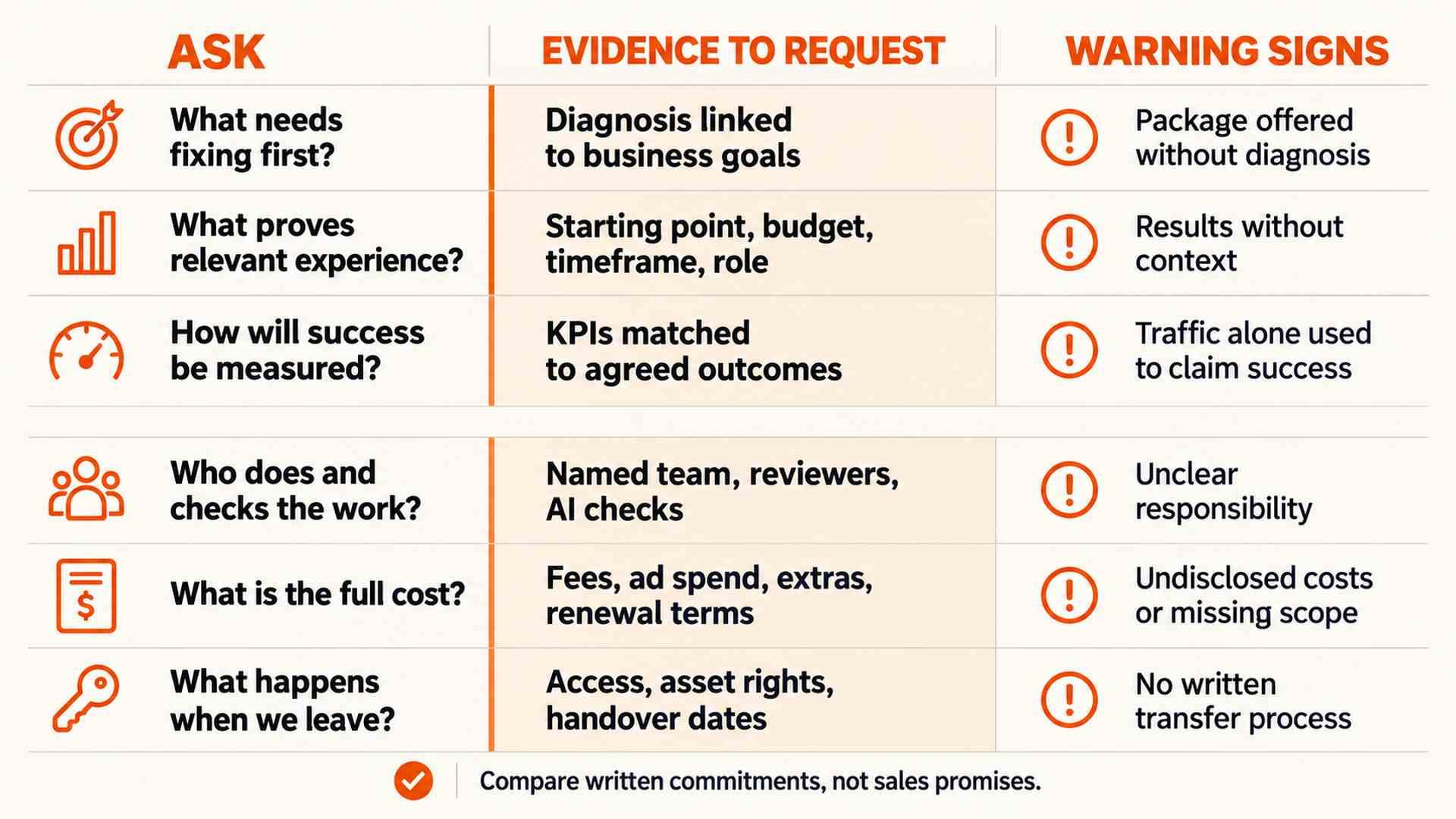
How to choose a marketing agency from the written answers
Compare each proposal against six checks: diagnosis, relevant evidence, measurement, responsibilities, full cost, and exit arrangements. Flag missing answers for clarification before deciding.
Keep the agreed scope, measurement plan, and commercial terms together. Have the budget owner and daily contact read them before signing. The documents should let both people understand what is being bought and how the relationship will be managed.
Need help taking the next step? Tell us what your business needs. Falcon Reach can arrange an introduction to a relevant specialist team, with coordination and communication follow-up available when needed and requested. The specialist team agrees the scope and delivers the marketing work.
Related solution
Explore Digital Marketing →About this article
Falcon Reach connects businesses with the specialist teams in its own group of companies. This article is general information, not professional advice for a specific situation.
Falcon Reach
Falcon Reach connects businesses with the specialist teams in its own group of companies, for AI and automation, software, IT, design and marketing.
Continue reading
Who Owns Your Data and Code? Questions to Ask AI Vendors
Questions to ask AI vendors about data use, code rights, security and exit plans. Check contract terms and evidence before signing a new AI agreement.

Falcon focus. Real reach.
Falcon Reach connects businesses with the specialist teams in its own group of companies.